 uarkova
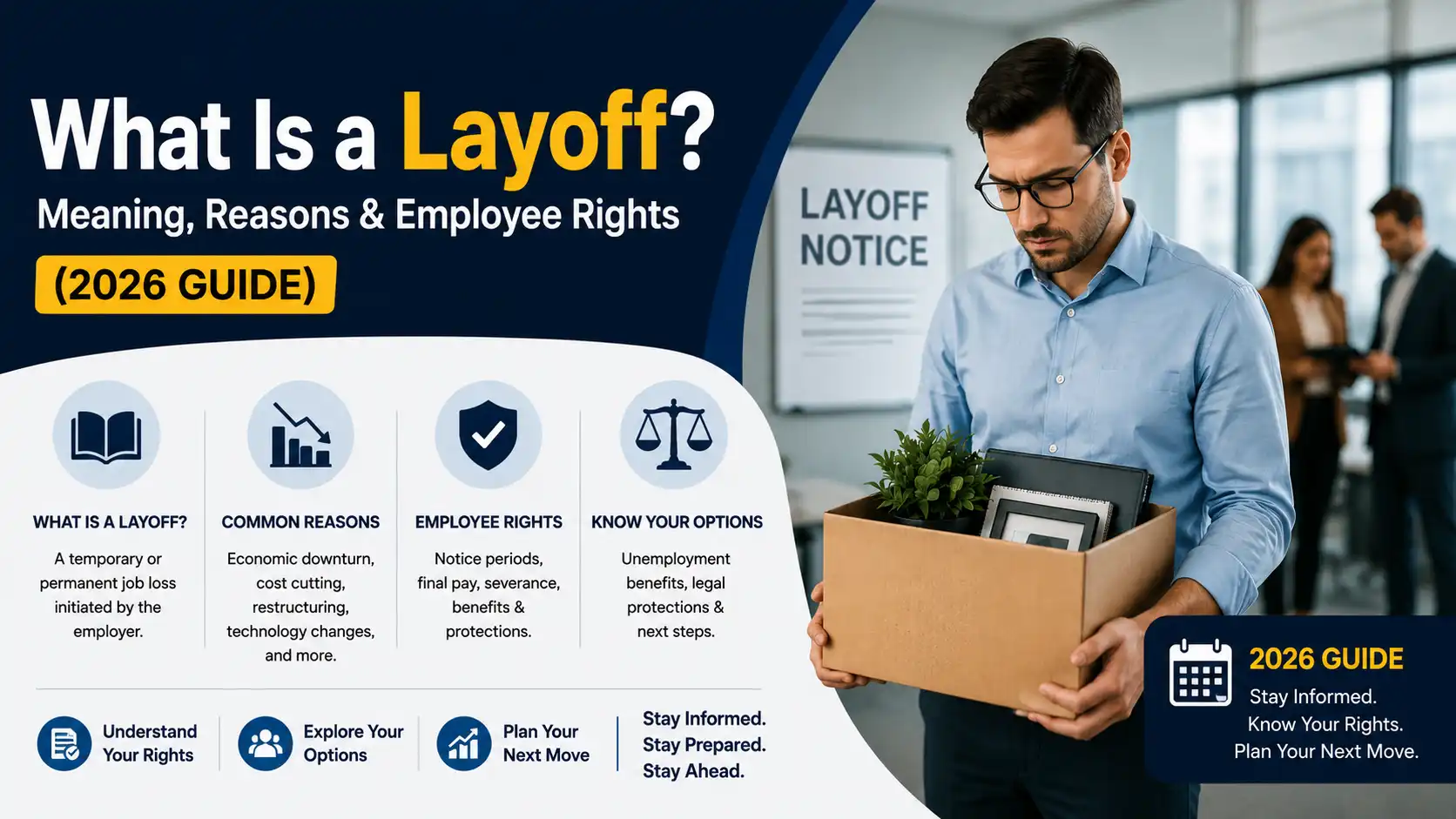
What Is a Layoff? Meaning, Reasons & Employee Rights (2026 Guide)
What Is a Layoff? Meaning, Reasons & Employee Rights (2026 Guide)
Layoffs have become one of the most talked-about workplace topics of the past few years. From tech giants trimming thousands of roles to smaller businesses restructuring after economic shifts, almost every industry has felt the impact. But what does "layoff" actually mean, why do companies do it, and — most importantly — what rights do employees have when it happens to them?
This guide breaks it all down in plain language, so whether you're an employee trying to understand your situation or an employer trying to handle the process correctly, you'll know exactly where you stand in 2026.
What Is a Layoff? (Meaning & Definition)
A layoff is when an employer ends the employment of one or more employees for reasons unrelated to the employee's individual performance or conduct. Instead, layoffs are driven by the business itself — things like financial pressure, restructuring, automation, or a drop in demand for products or services.
In simple terms: a layoff isn't about you doing something wrong. It's about the company needing to make a change.
Layoffs can be:
- Temporary — employees may be recalled once conditions improve
- Permanent — the position is eliminated entirely
- Individual — a single role is cut
- Mass layoffs — large groups of employees are let go at once, often triggering specific legal notice requirements
Layoff vs. Termination vs. Firing: What's the Difference?
These terms get used interchangeably, but they mean different things:
| Term | Reason | Employee's Fault? |
|---|---|---|
| Layoff | Business-driven (cost cuts, restructuring, automation) | No |
| Firing / Termination for cause | Performance, conduct, or policy violations | Yes |
| Furlough | Temporary unpaid leave, job is retained | No |
| Resignation | Employee chooses to leave | N/A |
Understanding which category applies matters — it affects eligibility for unemployment benefits, severance, and how the event appears in future reference checks.
Why Do Companies Lay Off Employees? (Common Reasons)
1. Economic Downturns or Recession Pressures
When revenue drops or borrowing costs rise, companies often cut payroll — typically their largest expense — to stay solvent.
2. Restructuring or Mergers & Acquisitions
After a merger, acquisition, or internal reorganization, duplicate roles are often eliminated.
3. Automation and AI Adoption
As AI tools and automation take over repetitive tasks, some roles become redundant — a major driver of layoffs in 2024–2026 across tech, customer service, and administrative functions.
4. Outsourcing or Offshoring
Companies may move roles to lower-cost regions or third-party vendors.
5. Declining Demand or Loss of Clients
A drop in sales, a lost contract, or reduced demand for a product line can force headcount reductions in that division.
6. Overhiring Correction
Many companies that hired aggressively during growth periods later have to "right-size" their workforce when growth slows.
7. Cost-Cutting for Profitability or Investor Pressure
Public companies under pressure to improve margins sometimes reduce headcount to boost profitability metrics.
Signs a Layoff Might Be Coming
While layoffs can happen without warning, some common signals include:
- Hiring freezes across the company
- Leadership changes or a new CFO focused on "efficiency"
- Missed earnings targets or public statements about "cost discipline"
- Budget cuts to your team or department
- Increased use of vague language like "restructuring" or "streamlining operations"
Employee Rights During a Layoff (2026)
Employee rights during layoffs vary by country and, in the U.S., by state — but several protections are broadly recognized. Always confirm specifics with your local labor authority or an employment lawyer, since laws differ by jurisdiction.
1. Advance Notice Requirements
Many countries and regions require employers to give advance notice before mass layoffs. In the U.S., the WARN Act (Worker Adjustment and Retraining Notification Act) generally requires employers with 100+ employees to give 60 days' written notice before a mass layoff or plant closing. Many U.S. states have their own "mini-WARN" laws with additional requirements.
2. Right to Severance Pay (Where Applicable)
Severance isn't legally required everywhere, but it's common practice — and sometimes contractually guaranteed through an employment agreement, company policy, or collective bargaining agreement. Severance amounts often scale with tenure.
3. Right to Unpaid Wages and Accrued Benefits
Employees are generally entitled to:
- Final paycheck for hours worked
- Payout of accrued but unused vacation/PTO (depending on local law and company policy)
- Continuation of certain benefits for a defined period
4. Protection Against Discriminatory Layoffs
Layoffs cannot be used as a cover for discrimination based on age, gender, race, disability, pregnancy, or other protected characteristics. If layoffs disproportionately target a protected group, it may constitute unlawful discrimination even if labeled a "business decision."
5. Right to Continued Health Coverage
In the U.S., laid-off employees are typically eligible for COBRA continuation coverage, allowing them to keep their employer-sponsored health insurance temporarily (usually at their own cost).
6. Right to Apply for Unemployment Benefits
Employees laid off through no fault of their own are generally eligible for unemployment insurance benefits, subject to local eligibility rules.
7. Right to a Reference and Documentation
Employees can typically request confirmation of employment, reason for separation, and — where applicable — a neutral or positive reference, especially if negotiated as part of a severance agreement.
8. Right to Review Separation Agreements
If asked to sign a severance or separation agreement (especially one that includes a waiver of legal claims), employees generally have the right to review it and, in many jurisdictions, a legally mandated review period before signing.
What Employers Should Do During a Layoff (Best Practices)
While this guide focuses on employee rights, employers handling layoffs responsibly in 2026 typically:
- Provide as much advance notice as legally and practically possible
- Communicate clearly and directly, avoiding vague corporate language
- Offer outplacement support, resume help, or job-search resources
- Ensure severance and final pay are processed promptly
- Apply layoff criteria consistently to avoid discrimination claims
- Document the business rationale behind each decision
What to Do If You've Been Laid Off: A Quick Checklist
- Read everything before signing — especially severance agreements
- Ask about your final pay date, accrued PTO, and benefits end date
- Apply for unemployment benefits as soon as you're eligible
- Update your resume and LinkedIn promptly
- Request a reference letter if possible
- Check COBRA or local health coverage options
- Consult an employment lawyer if you suspect discrimination or a rights violation
Frequently Asked Questions (FAQs)
Is a layoff the same as being fired?
No. A layoff is due to business needs, not employee performance or conduct, while being fired usually relates to individual performance or misconduct.
Do all laid-off employees get severance pay?
Not always — it depends on local law, employment contracts, and company policy. Some companies choose to offer severance even when not legally required.
Can I collect unemployment benefits after a layoff?
In most cases, yes, since layoffs are considered involuntary and not the employee's fault — though eligibility rules vary by location.
How much notice must an employer give before a layoff?
This depends on the jurisdiction and company size. In the U.S., the WARN Act requires 60 days' notice for qualifying mass layoffs; other countries have their own statutory notice periods.
Can a company lay off employees based on age or other personal characteristics?
No. Layoffs must be based on legitimate business reasons. Using layoffs to disguise discrimination is illegal in most jurisdictions.
Final Thoughts
Layoffs are rarely easy — for the employees affected or the organizations making the decision. Understanding what a layoff actually means, why it happens, and what rights protect you can make a stressful situation far more manageable. If you're facing a layoff in 2026, take the time to review your rights, ask questions, and seek professional advice where needed — knowledge is your best tool for navigating the transition confidently.